


Advertisement
Report date: 13th November 2026
Full Report
AWI Commentary
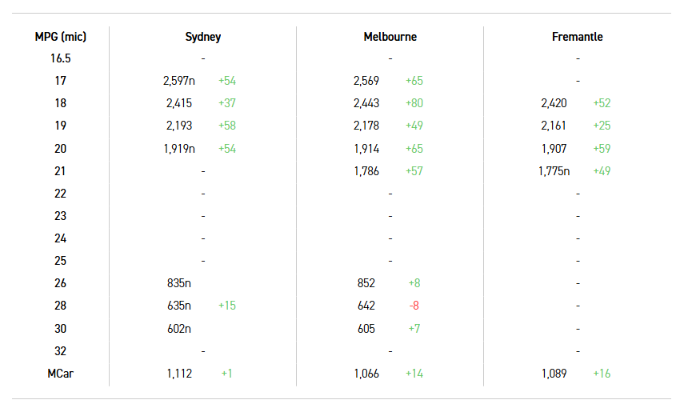
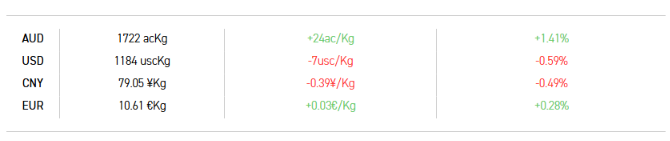
The Australian wool market rebounded this week, ending four consecutive weekly declines as stronger buyer competition and a lower Australian dollar provided renewed support. The Eastern Market Indicator (EMI) gained 24 cents to close at 1,722 A¢/kg, although in US-dollar terms the EMI fell seven cents to 1,184 US¢/kg, indicating currency movements contributed to the recovery in local prices.
A total of 27,077 bales were offered nationally, 2,055 more than the previous week, with 25,216 bales sold and the pass-in rate falling to 6.9%. Price gains extended across all Merino microns, including broader descriptions which had experienced considerable pressure in recent weeks.
From the start, Tuesday’s market opened strongly, with the EMI gaining 24 cents, its largest daily rise since early September. Merino categories increased across the country, with good-style, well-measured wool again attracting the strongest competition. Chinese processors were particularly active with exporter-traders following closely.
Wednesday brought consolidation, with the market remaining relatively unchanged and traders became more prominent. Better-style and specification wool, particularly low mid-break and low-CVH descriptions, attracted significant premiums, while poorer-quality and broader topmakingtypes remained comparatively subdued.
Underlying supply remains constrained, with season-to-date offerings13.0% below last season. Despite the recent market correction, the EMI remains 233 US cents, or 24.5%, above the corresponding sale last season, compared with an 18.1% increase in Australian-dollar terms. This highlights the substantial year-on-year improvement in wool prices from an international buyer’s perspective, despite recent currency-driven volatility.
With approximately 30,500 bales forecast for Week 21, the market will face another test of whether renewed processor participation and improving clearance rates signal more sustainable demand, or whether recent gains primarily reflect currency movements and short-term inventory requirements
Advertisement
Buying sheep in New South Wales?
Check out what's for sale on the the Agora Livestock Marketplace


